

Author: Kelli Albracht

Wellcome Collection

I was excited to visit the Wellcome Collection because I am a graphic design major, so I was interested to see what the exhibit was going to be about. I don’t think very many people realize how often graphic design is used and what a central role it has in society. Learning about it has made me more aware, but I still did not know very much about graphic design used in medicine, and I also had not really thought about how important it is. Medicine and health has to be advertised and represented correctly because it could be dangerous if something is misinterpreted.

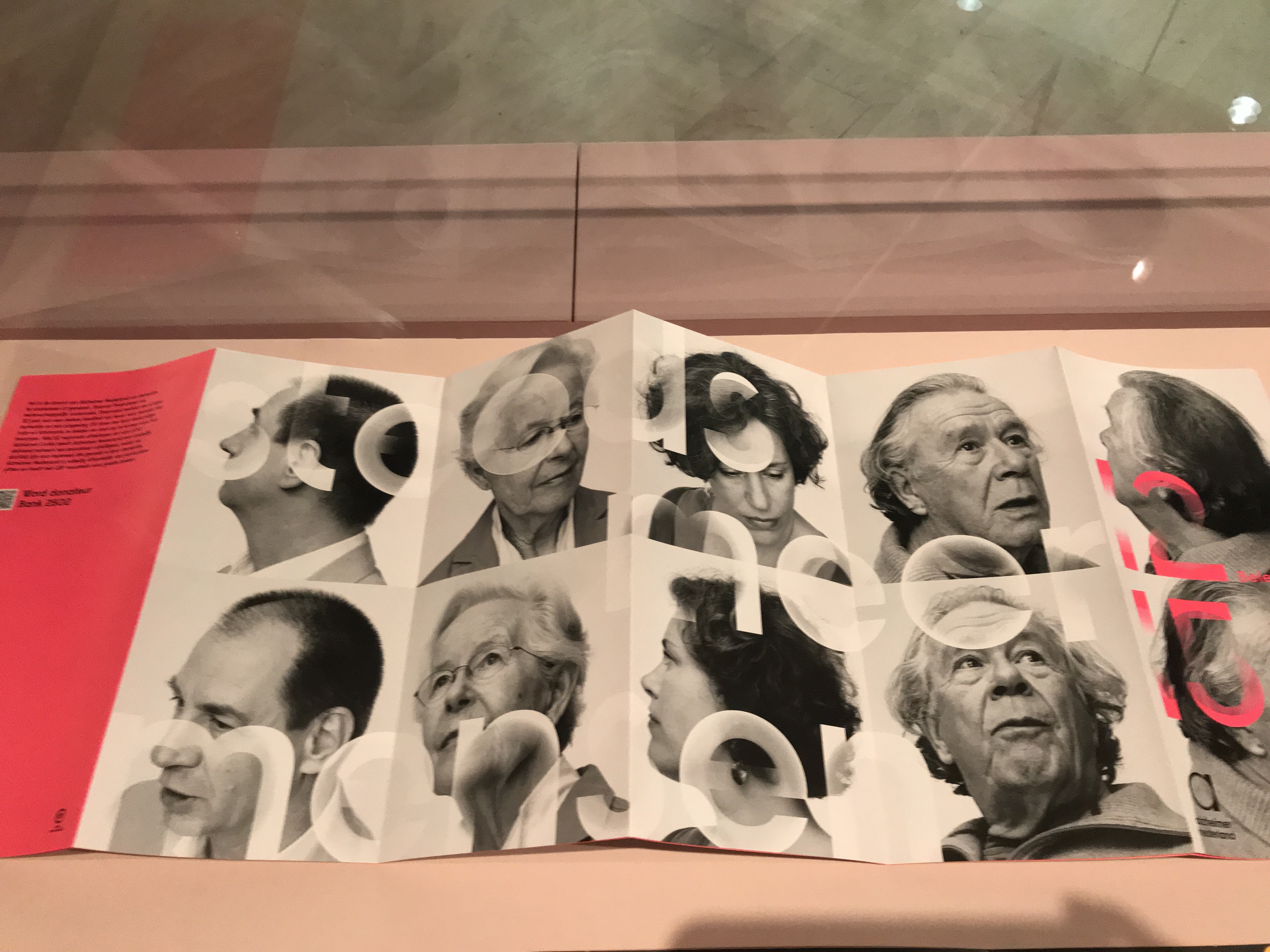
One of the things that stood out to me was the dementia poster that was created in 2012 by Studio Dumbar in the Netherlands. The fading letters are a great representation of Alzheimer’s and I think they are almost more impactful without the people in the background. In the exhibit, there was information about how the change in design was meant to change the way that people react to dementia because the old logo, a tree with falling leaves, had negative connotations. The fading letters represent the fading memories of those with Alzheimer’s while still being bright, so it is more positive (“Can Graphic Design Save Your Life?”).

The second thing that stood out to me was the way that Teva was able to use colors and shapes to use packaging as a way to explain what products are and how they should be taken. It is a simple way to make sure the information on the packaging is very clear. I thought this was a good example of how creative design can be even just for simple packaging. The whole exhibit demonstrated how designers are constantly coming up with new ways to present information that people need to know in exciting ways.

British Library

During our trip to the British Library, the thing that stood out to me most was Gutenberg’s Bible. As a graphic design major, I have learned briefly about the history of the printing press and its impact. Seeing the Bible in person was a really cool experience and it was interesting to see in person how small the text actually was.

According to the British Library website, Gutenberg’s Bible was printed in 1455, but it was actually not the first printed book. China and Korea were already using woodblock printing and moveable type, but the Gutenberg Bible was the first printed book in the Western world (Gutenberg Bible). Hellmut E. Lehmann-Haupt wrote that Gutenberg originally kept his invention of the printing press a secret, but was forced to enter into a lawsuit with Johann Fust, one of his investors. Fust ended up winning and gained all of Gutenberg’s work, taking the credit for the printed books. Gutenberg did not end up gaining credit for his work until after his death (Lehmann-Haupt).

The reason that Gutenberg’s invention was so useful is that the individual letters could be moved and rearranged to form new words on new pages. He also used a press to print the pages, so it was possible to use both sides of the paper and the process was faster (Gutenberg Bible).

Even though Gutenberg’s process made it possible to print multiple pages of the same text at a faster pace, I still cannot imagine how long it took to organize each individual letter to be printed. Looking closely at the Gutenberg Bible, as well as the other books around it, it was interesting to compare the printed books to the books that had been written by scribes. The scribes wrote so precisely that the writing almost looked like the printed text, but you could tell the difference in the amount of ink between each letter since they had to use a quill. Another thing that was fun to see in person was the intricate illustrations on the Bible, as well as the other books in the room, that gave it the decoration of an illuminated manuscript. Overall, seeing all of the books displayed in the gallery, but especially the Gutenberg Bible, was interesting because I had only ever seen pictures. It was nice to be able to compare images from textbooks to the real objects.